
From the Sleuth's desk
How difficult is a Sudoku, really?
Sudoku Sleuth · · 6 min read
You're all familiar with this: I frequently feature 1 or 2 star puzzles, only to find them harder than the community rated them. This is why I started measuring the logic inside a puzzle, and what the fedora hats mean when you choose your next one.
In this entry
A lunch that reignited a year-old spark
A year or so ago, you may remember, I went off on a tangent in a video about the constraints on a cell. How lovely it would be to have something that uses colours to show the number of constraints on every cell, almost highlighting which cells are likely to break first. I parked that idea, and didn't come back to it until I sat down for lunch with the lovely FullDeck and Missing a Few Cards.
We got talking about difficulty. They both felt, and I agreed, that the difficulty of variant Sudoku seems to be climbing: today's 1 star puzzle was yesterday's 2 star puzzle. From their experience, it's almost creating a barrier to entry for new solvers joining this wonderful community of variant Sudoku.
I went home with that conversation swimming around my head, thinking: I can do something about this.
How the solver works: look at the steps
I built on top of that constraint idea. Rather than take the path of typical solvers, brute-force trial and error of every digit, I wanted a solver that can help me when I get stuck. One that finds recognisable logical deductions, the way I explain them in my videos, and the reasons behind them.
It looks for placements and eliminations using techniques such as singles, pairs, colouring and chains, alongside the puzzle's variant rules. Those rules matter. A thermometer, a killer cage or a whisper line can each tell you something before you've placed a digit.
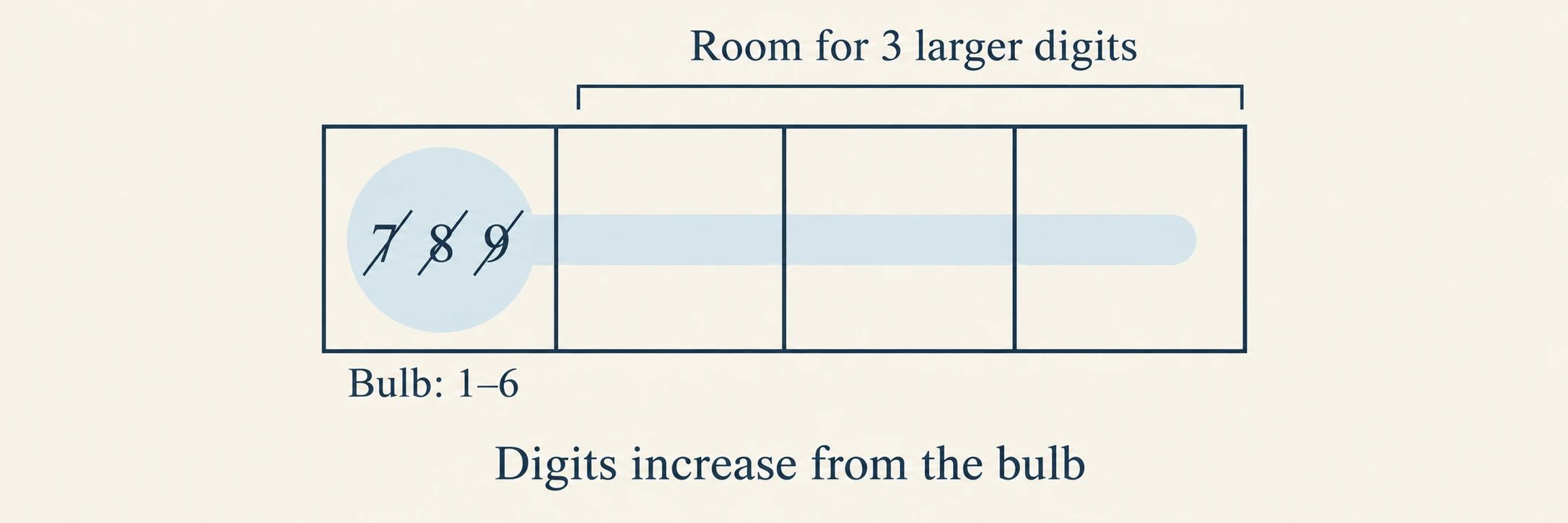
Take an ordinary four-cell thermometer in a puzzle using the digits 1 to 9. Its digits rise from the bulb to the tip. The bulb cannot be 7: there would be room for 8 and 9, but no fourth, larger digit. The same reasoning rules out 8 and 9 at the bulb.
You've learned something without guessing. The solver records that deduction and why it works.
Some steps need one observation, one constraint. Others bring several observations together. I score that logical work, including the techniques and the rules involved, to build a picture of the solve.
Why the hardest step gets the hats
The site shows difficulty with one to five fedora hats. The rating comes from the highest-scoring step in the solver's recorded path.
A long puzzle made of familiar moves can take a while. A shorter puzzle can stop you with one deduction you've never met before. I want the hats to help you anticipate that hurdle, rather than simply count how many cells need filling.
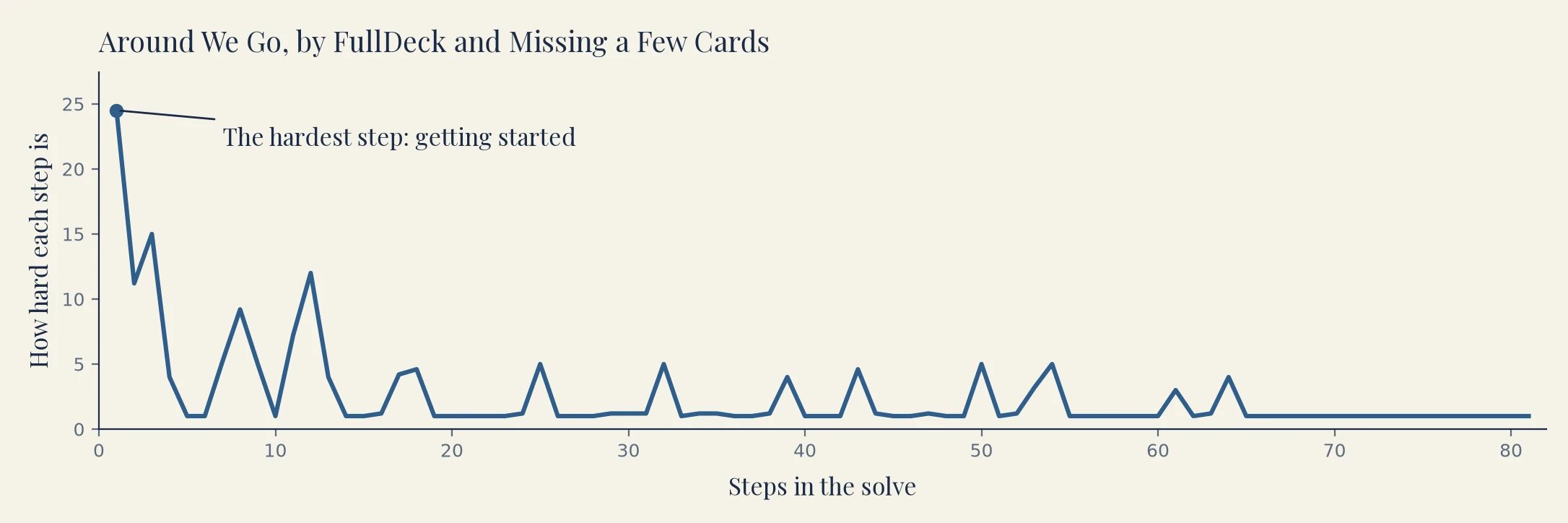
Below are difficulty curves of a couple of puzzles on the site, straight from the solver. Each step (typically 1 to 81 on a 9×9 Sudoku) gets a difficulty rating based on the techniques and the number of deductions you need to fill in a digit.
The solver consistently picks the easiest step, the one that unlocks more constraints and makes the next deduction easier.
In a way, the graph is literally the easiest, most elegant path through a puzzle, and it gives you real insight into the journey you're about to embark on.
Most puzzles have a hard opening: the break-in.
When the hard part comes later
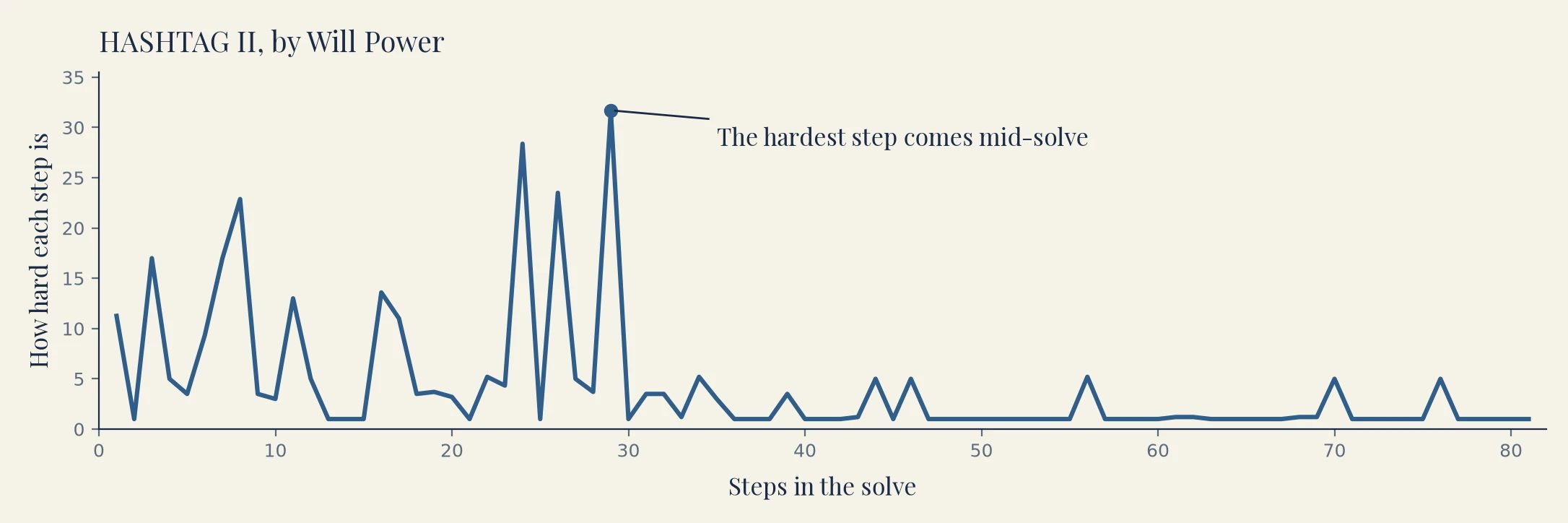
Now and then a puzzle saves its surprise for later. HASHTAG II by Will Power starts gently, then asks for its hardest deduction about a third of the way in.
The hats are the same either way: they measure the hardest deduction you need to make to fully solve the puzzle.
Enjoyment deserves its own question. After a solve, the stars ask how much you liked the puzzle. A gentle puzzle can be wonderful, and a difficult one can be wonderful for entirely different reasons. In time I hope to learn from solvers what makes a great puzzle. Stay tuned for when I figure that out!
Where your experience comes in
In the comments on the relaunch video, a viewer suggested using completion times, adjusted for each player's strength. I like that idea, and it connects with where I want this to go.
The logic gives us a consistent starting point. Real solves can help refine how much weight we give different kinds of reasoning. Someone fluent in colouring may fly through a step that keeps me staring at the grid. You already know how much trouble I can get into with classic Sudoku.
I'm planning to use coaching timings to refine those technique weights, accounting for differences in player speed. That will help the scale reflect how people actually solve, while keeping the reasons behind a rating visible.
What interests me most is the sense of progression. A puzzle that challenged you last month may feel comfortable now because you've learned to see something new.
A rating should help you play
Keeping the reasoning behind each step makes the rating useful beyond choosing a puzzle.
Now that we have a solver, can I nudge people in the right direction when they get stuck? You don't need a video for every puzzle: a solver can give you hints.
When you're stuck, a hint can point you towards the next observation. The three stages give you somewhere to look, a question to consider, and then the deduction. You choose how much help to reveal.
That same reasoning also makes it possible to explain a step in plain words and look back over your own solve. It gives us a way to connect the moment you got stuck with something you can practise.
For me, that's the exciting part: finding a puzzle you want to play, learning something from it, and carrying that into the next one.
Choose a case and try the hints.
Or start with how thermometer bounds work, then try a thermo puzzle.
What makes a puzzle feel difficult to you: spotting the first move, keeping several possibilities in mind, or recognising a technique you haven't used before? I'd love to hear from you: use the Send feedback button at the bottom of any page.